

Most writing prompt lists have one goal: keep the child writing. This one has a different goal.
Each of the ten prompts below isolates a specific skill gap common in grades 3–6. The prompts are simple enough that any child will attempt them.
What matters is not whether they finish, but what the response reveals. Give your child the prompt, read what they write, then read the "what to look for" note.
The 10 Prompts
What to look for: Can your child state a position and give a reason that supports it, or do they just assert? "Schools should have no homework" is a claim without a reason. "Schools should have no homework because kids need time to rest" has the minimum structure. From grade 4 onward, claim-and-reason is a baseline expectation. If it's missing here, that's the gap to close.
What to look for: Note the adjectives. "Nice," "big," "cool stuff" convey nothing specific. "A blue beanbag chair pushed against the wall" or "a pile of books that never quite fits on the shelf" shows observational detail. A child who can only produce vague descriptions hasn't yet learned to write from direct observation, and that will limit every genre they tackle.
What to look for: Read the first word of each sentence. If most start with "I," or if every sentence is the same length, sentence monotony is the gap. It's one of the most invisible problems in grades 3–4 writing. The content often sounds fine, masking the structural repetition underneath. Variety in sentence openings and length is a clear signal that a child is developing a more mature prose rhythm.
What to look for: Do they use sequence markers — first, then, after that, finally — or does each step arrive as a disconnected sentence? Children who produce unordered, step-skipping responses tend to have the same structural gap in essay writing: they reach for content before organizing it.
What to look for: First-instinct responses ("Rain is wet. It falls from the sky. It makes noise.") show that descriptive vocabulary isn't yet active. Better responses reach for specifics — the sound on a window versus a roof, the way pavement darkens, the smell before it arrives. A child who defaults to the obvious hasn't yet built the habit of looking past the first word that comes to mind, and that habit is what separates flat writing from engaging writing.
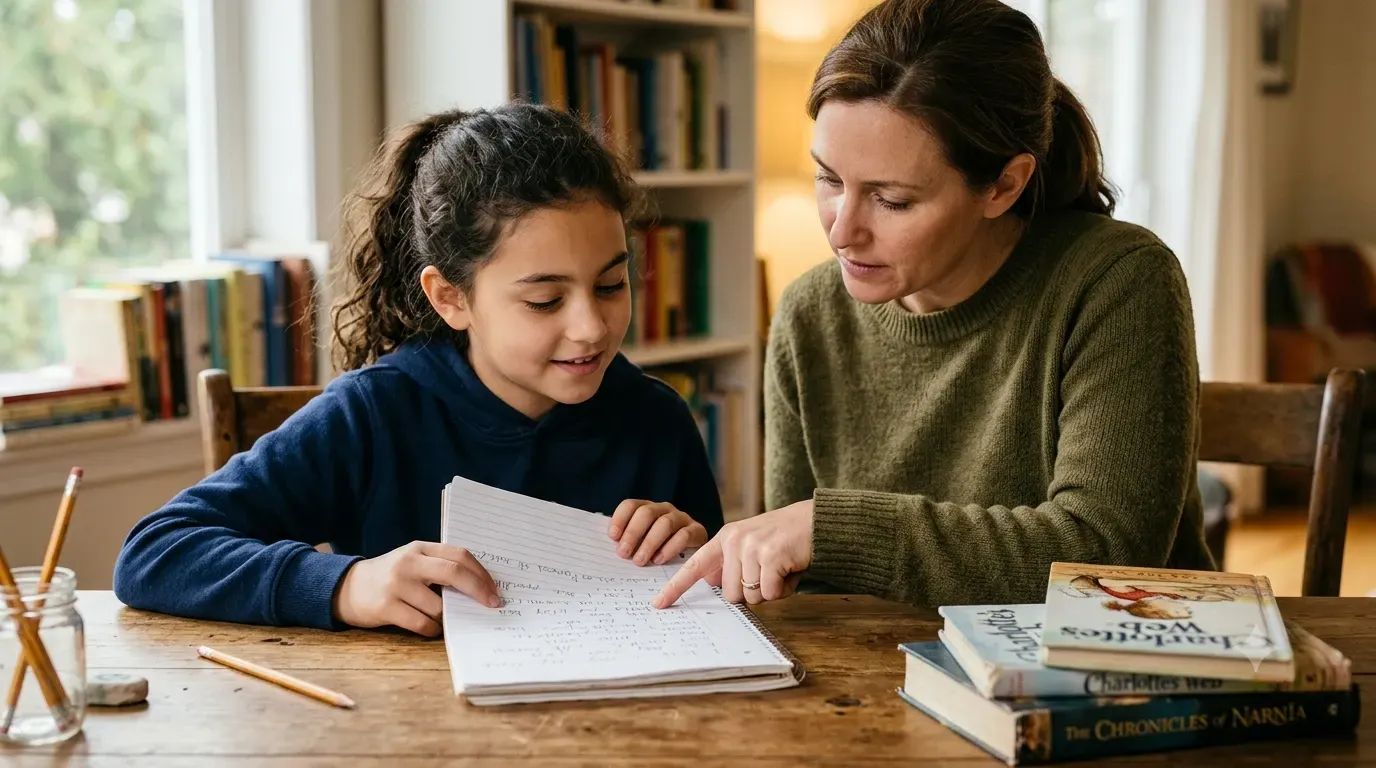
What to look for: The phrase "include everything important" removes the external organizer and shows whether your child has an internal one. Does the response stay on the animal, or does it wander? Starting with facts, drifting into a memory, then ending somewhere unrelated — children who can't hold a topic in writing reveal an organizational gap that compounds in every multi-paragraph assignment.
What to look for: Count the verbs. Are they weak defaults — was, went, looked, got — or do any carry specific weight: stumbled, crouched, froze? Weak verbs are one of the clearest signals that a child's vocabulary isn't yet transferring into writing. They usually know better words than they're using; they just need practice reaching for them.
What to look for: How does the response end? Does it stop mid-thought, trail off, or land somewhere? "And it was the best day ever" is a placeholder conclusion — present but hollow. A specific ending detail, or a return to something mentioned earlier, signals genuine awareness of how writing closes. Conclusion writing develops late and is usually invisible as a gap until middle school essays demand it.

What to look for: Does your child stay inside the pencil's experience throughout, or do they slip back into their own? Can they imagine what a pencil would notice? Children who can't maintain an unfamiliar perspective here will later struggle with character writing, narrator analysis, and the perspective-taking that literary response requires.
What to look for: Does the response acknowledge that the reader doesn't want to be convinced, or does it simply list reasons as if writing to someone already willing to agree? A child who ignores the audience's position is listing facts, not persuading. Audience awareness is usually the last writing skill to develop at this level, and the one that makes the most difference in real-world communication.
What to Do With What You Find
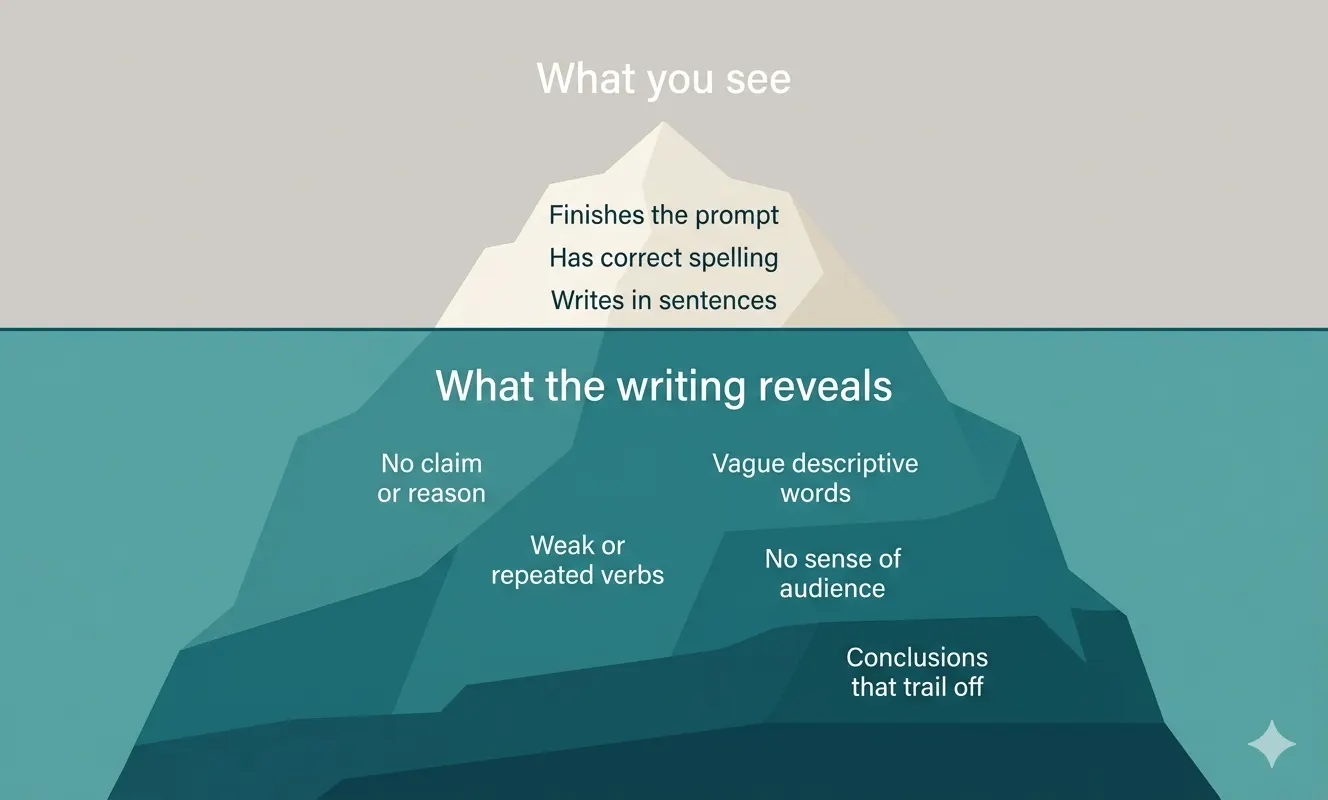
Look for patterns across the ten responses, not single answers. A child who drifts in prompt 6 and writes hollow endings in prompt 8 needs structural practice. A child who defaults to vague description in prompt 2 and weak verbs in prompt 7 needs active vocabulary work specifically in writing contexts.
Cueword gives kids AI feedback on exactly this kind of open-ended writing — not a score, but a specific note on what their response did and didn't do, and how to improve it. If writing is the gap you've identified, that kind of targeted feedback on real responses is where practice starts to move the needle.
If the prompts have shown you a gap, the next step is regular practice with real feedback. Cueword's writing sessions use open-response prompts just like these — and give your child specific, sentence-level AI feedback after every response.
Book a free evaluation →Frequently Asked Questions
Real progress needs a real coach
See where your child's English stands — book a free 50-minute 1:1 evaluation with a Cueword coach.
Book a free evaluation →